

CASE STUDY · LPI · 2024–2026
Parishes Online
I won ownership of a 15-year-old Catholic church directory with about 9 million visitors a year, then redesigned it, and its data, around the people who use it.
Blue, purple, amber: site visitors, church staff and advertisers, the three groups the directory serves.
MY ROLE
Product owner (official title: Product Design Manager)
TIMEFRAME
Ownership from late 2024; roadmap from Q4 2024 into 2026
TEAM
Engineering manager and engineers, a brand designer, sales, marketing and creative services
PLATFORM
Parishes Online (POL), MassTimes.org, Google Maps, Hotjar, Figma, Adobe XD
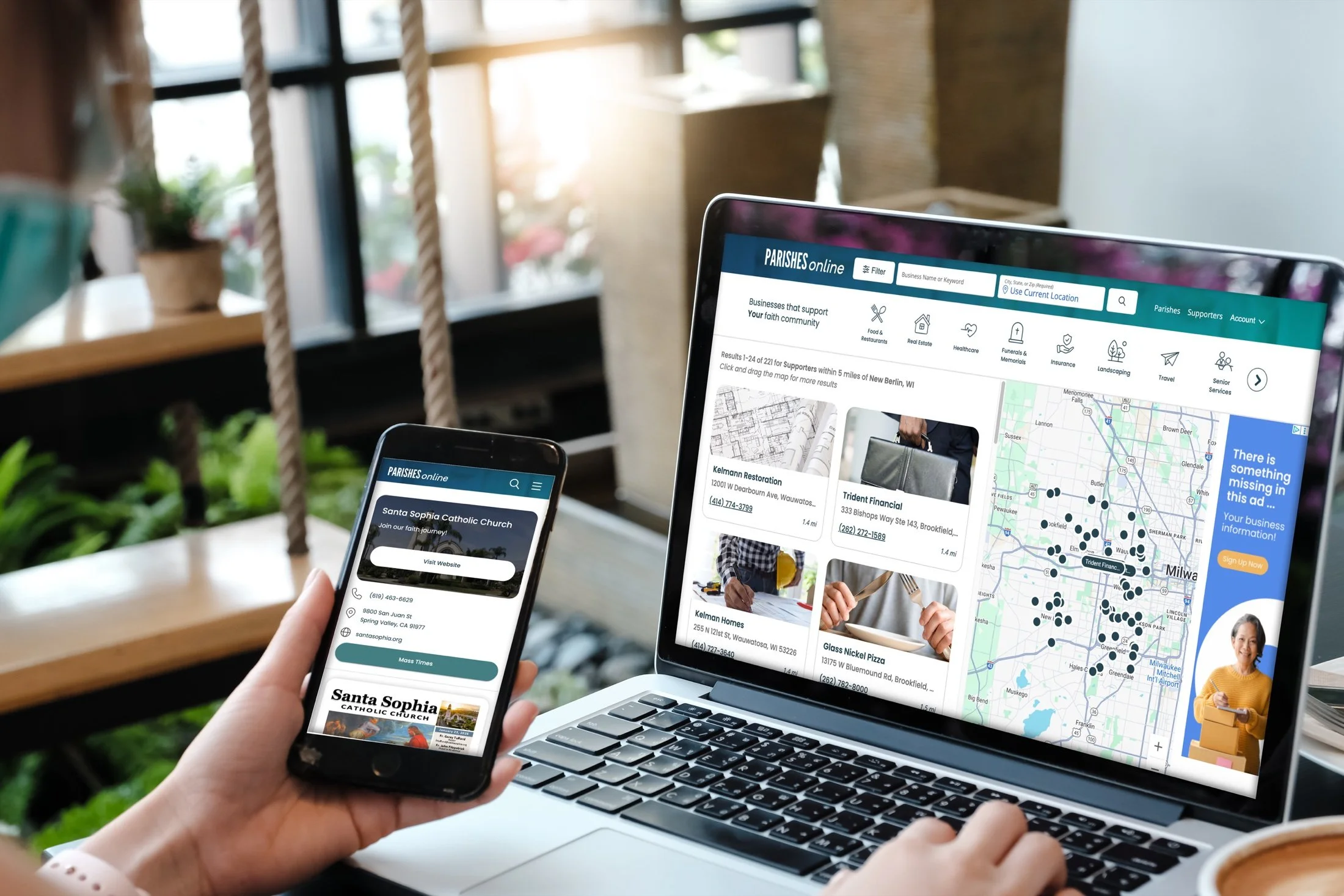
WHERE IT STARTED
A directory built for bulletins, carrying a digital ad business
Parishes Online launched in 2009 as “Seek and Find,” a place to read printed church bulletins online and connect them to the businesses advertising in their pages. LPi had experimented with digital advertising for years. It gained traction in 2019 and took off in 2020, and when this project began in 2023, the 2024 goal for digital revenue was $3.43 million.
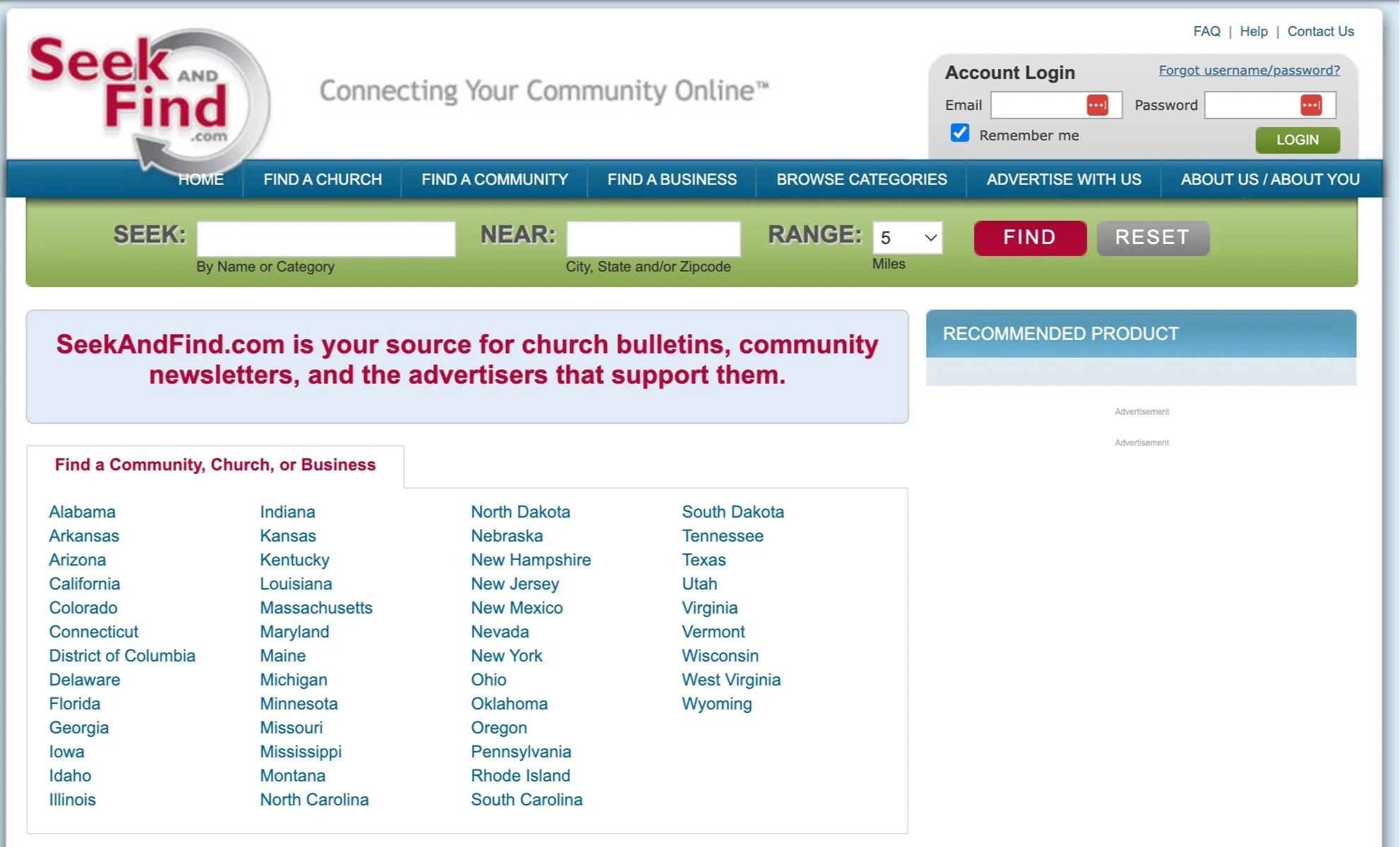
2009
Seek and Find, the platform’s original 2009 home page.
THE PROBLEM
A 15-year-old platform with no owner
The directory serves Catholic parishes and about 60,000 advertisers, but no one had owned it as a product for more than a decade.
No product owner. No one had been responsible for the platform for over a decade.
Sprawl. Features and ad slots had been added one at a time, which left incoherent systems and shallow internal knowledge of how they worked.
A spammy experience. Visitors found the interface cluttered and frustrating.
Admins locked out. Church administrators struggled to log in, update content or control their listings.
Ad sales without structure. The ad infrastructure was increasingly hard to support.
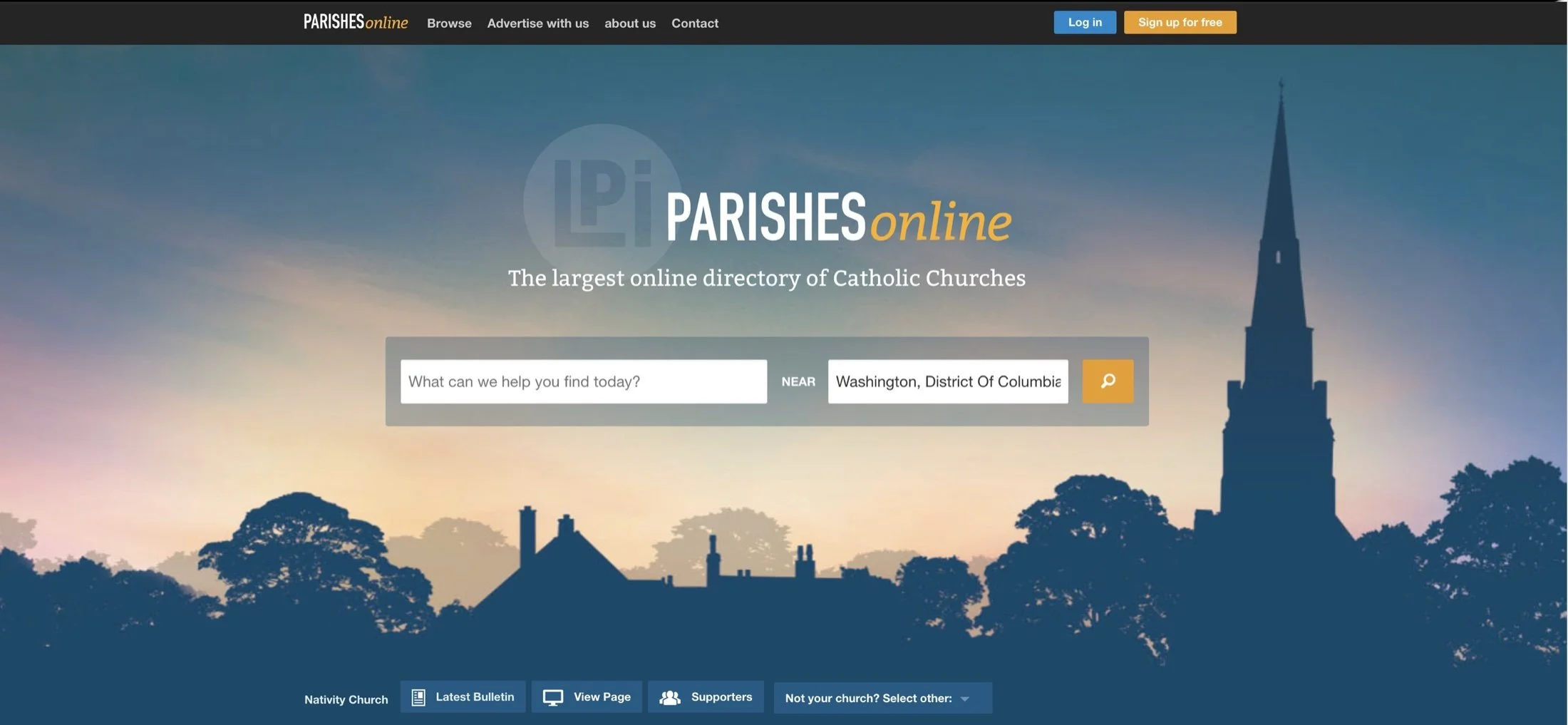
BEFORE THE REDESIGN
Parishes Online before the redesign.
MY ROLE
Product owner, from vision to delivery
As Product Design Manager, I took on the role of product owner for the directory and was responsible for strategic vision, research and insights, stakeholder alignment, UX design, feature requirements, and priorities and product execution.
I worked closely with:
The engineering manager, on the roadmap and bandwidth
Individual engineers, on requirements, feasibility, functionality and design
A brand designer, on the visual foundation
The VP of Sales, on business opportunities and communication
The VP of Marketing, on customer communication and brand
The Director of Creative Services, on aligning and enabling the ad design team
Managers across every department, for input and communication

WHAT IT STILL HAD
A big audience worth protecting
Despite all of this, the platform still had a large, loyal audience, strong SEO and high-value nonprofit content. Breaking it would have cost real revenue, so every change had to be made carefully.
~9M
visitors a year
~500K
email subscribers
~60K
advertisers
~6K
print clients
$3.43M
2024 digital revenue goal
2009
launched as Seek and Find
STRATEGY AND PLANNING
A vision first, then ownership
My team saw a long-overdue opportunity in the directory, but real progress needed leadership on board. To earn that trust, I presented a future-state vision to the CEO, built around three goals. It won executive buy-in, and in late 2024 I was given full ownership of the product.
The vision
A modern, cleaned-up user experience
Streamlined admin tools
Ethical, user-aligned ad placement that respects mission-driven content
The phases
Quick wins
Research and analysis
Strategy shifts and UX improvements
Positioning
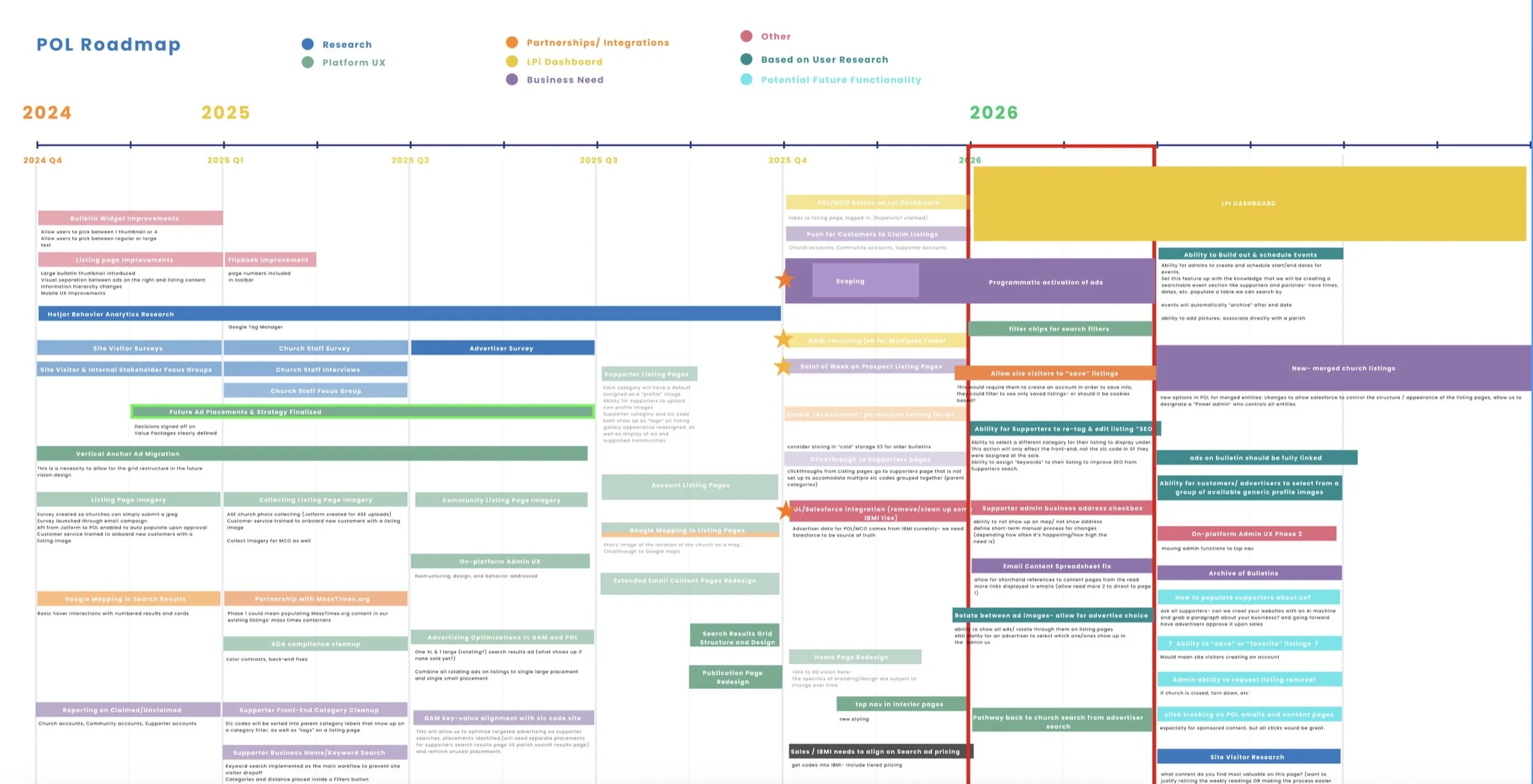
The roadmap I built and maintained: a living plan of goals and timeline, Q4 2024 into 2026.
DISCOVERY AND RESEARCH
Research with every group the platform serves
Site visitors. Pain points, how spammy or credible the site felt, and accessibility issues.
Church customers. Interviews and surveys on the login flow, content-management barriers, and a lack of clarity and control.
Advertisers. A survey on needs, behaviors and knowledge.
Internal stakeholders. Engineering, sales, support and leadership.
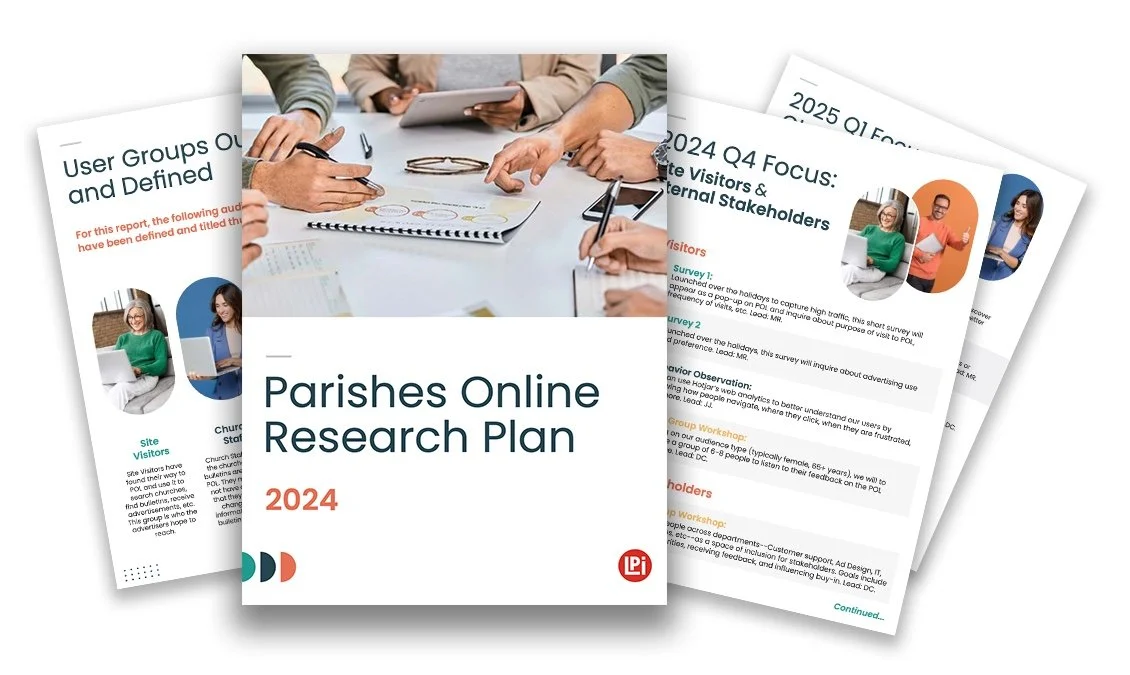
The 2024 research plan, with the groups and research methods for each quarter.
Decisions based on the research
SITE VISITORS
Awareness
Find the best way to share parish event information with all local audiences.
Make the relationship between churches and their supporters obvious at a glance.
Make POL filler ads bigger in bulletins.
Trust
Partner with MassTimes.org and remove unreliable data.
User experience
Move toward mobile-first design and reassess the bulletin reader on mobile.
Let churches highlight special Mass times with little or no effort.
CHURCH STAFF
Admin tools
Make the church staff admin experience more intuitive to edit.
Public listings
Find a display for merged parishes.
Add upcoming events.
Longer term, keep archived bulletins available.
Research best practices for reading on mobile.
Education
Plan how to raise awareness of POL with congregations and drive traffic through staff enablement, ad fillers and more.
ADVERTISERS
POL upgrades
Richer advertiser listing pages.
More eye-catching layouts that highlight advertisers to visitors.
Searchable keywords for advertisers.
A message box on listing pages so visitors can email the business directly.
Awareness
Add value to digital ad sales by promoting the digital bulletin and POL’s wider reach.
Announce the new POL experience, featuring the advertiser listing page.
Expand advertiser training on listing pages, claiming a listing and editing it.
EXECUTION
From requirements to shipped pages
Wrote feature requirements and worked with the engineering lead on scope and the implementation timeline.
Designed Figma and Adobe XD mockups for every new page, interaction state and screen size.
Found and cleared the legacy blockers that stood in the way of larger upgrades.
Kept engineering aligned through feature definition documents with acceptance criteria, weekly syncs with the development manager, and check-ins with individual engineers.
Set up a loop between research and delivery, so early implementations and designs were tested and improved.
Worked with ad ops and marketing to keep business goals and product direction aligned.
THE REDESIGN
Four pages, before and after
Home page
BEFORE
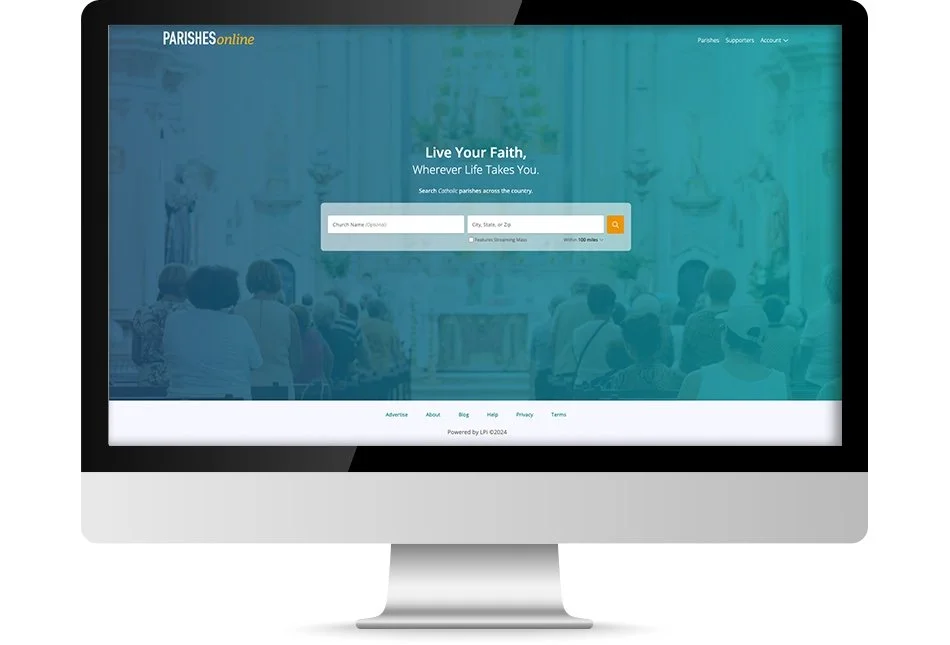
ISSUES FOUND
The old home page failed an accessibility audit, never explained the mission or the advertiser model, and made people work too hard. Search was rigid: it dropped results over small spelling differences such as “St.” and “Saint,” and offered no location-based discovery.
AFTER
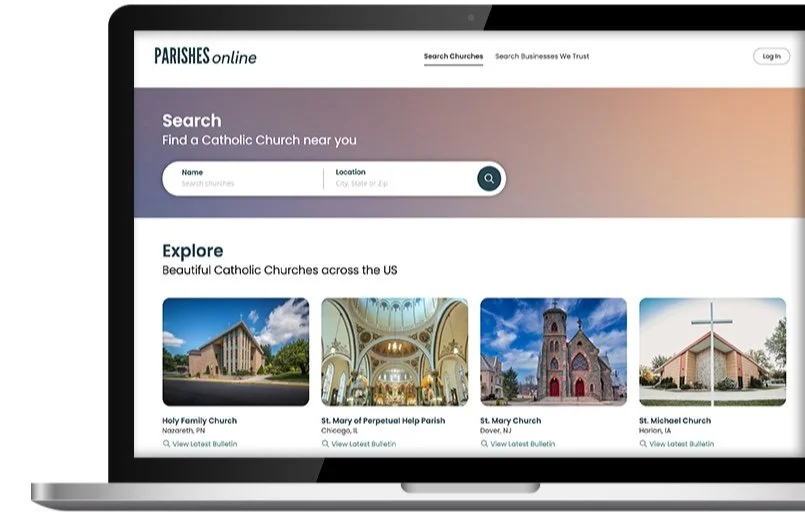
WHAT CHANGED
Community photos. Church-submitted photography replaced generic stock images. Churches have contributed nearly 1,000 photos so far, about 10% of our customer base.
Clear value, found by search. Headlines were rewritten from SEO research while staying human, so visitors quickly understand the site and find it organically.
Advertising out in the open. A rarely visited “Supporters” link became a home page section introducing local sponsors and how sponsorship works, with a new main call to action, “Search Businesses We Trust.”
Accessibility from the start. Contrast, hierarchy and keyboard-friendly interactions were requirements, not fixes.
A modern visual system. New type, spacing and layout for a more credible first impression.
One action per section. Each section has a single call to action, so visitors always know what to do next.
Search results
BEFORE
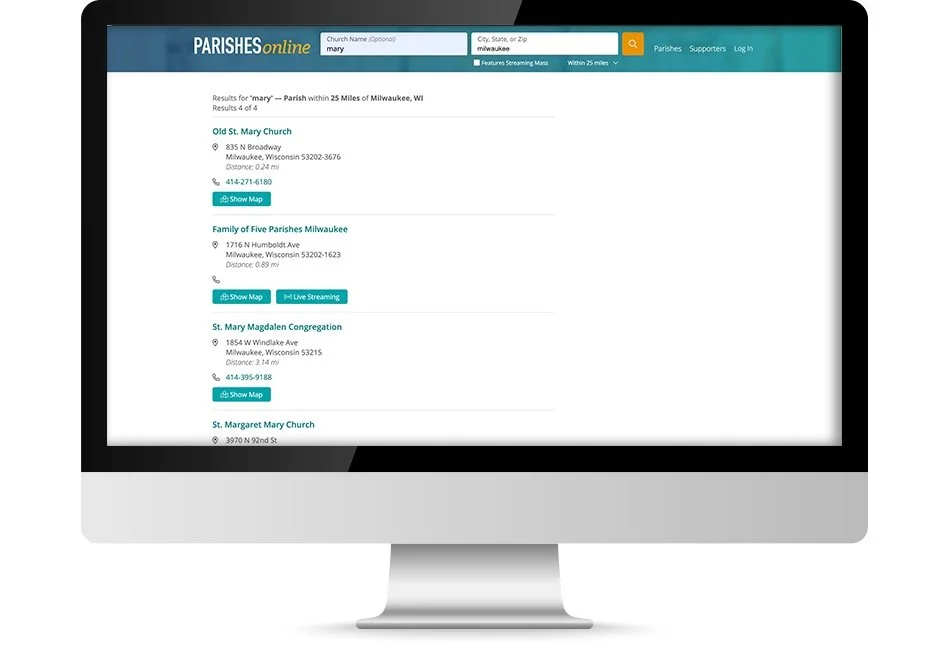
ISSUES FOUND
The old results page also failed an accessibility audit. Broken buttons, empty contact fields and page-by-page browsing made finding a church slow and error-prone, and sparse visuals and UI bugs eroded trust.
AFTER
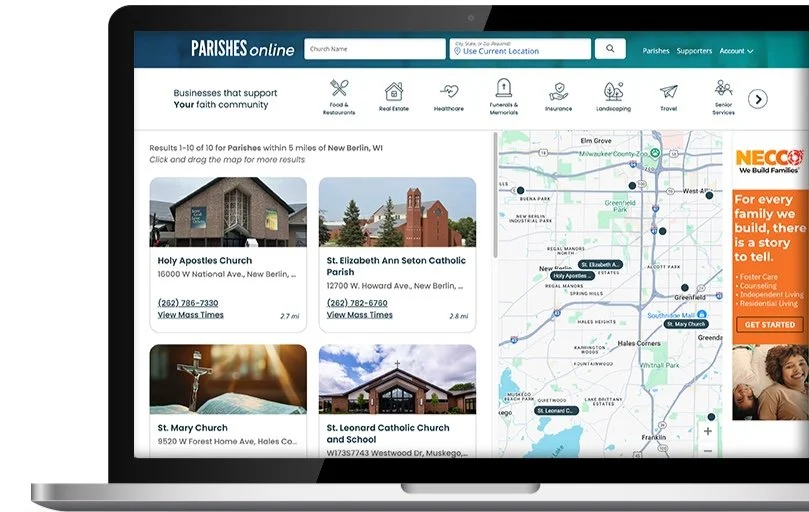
WHAT CHANGED
Church photos in results. Easier to scan, easier to recognize, and an invitation to explore nearby parishes.
An interactive Google map. Built for zooming, scanning and exploring an area, so the site works as a directory instead of a static list.
A rebuilt search ad system. Buggy, inconsistent ad units became a clear hierarchy: one rotating skyscraper sold by DMA, a smaller in-list placement, and matching mobile formats. Desktop and mobile are still sold together, but can now be sold separately. More in the Ad System Re-Architecture case study.
A path to local businesses. A banner at the top of results invites visitors to discover faith-supporting businesses nearby, sending traffic to advertiser listings.
Church listings
BEFORE
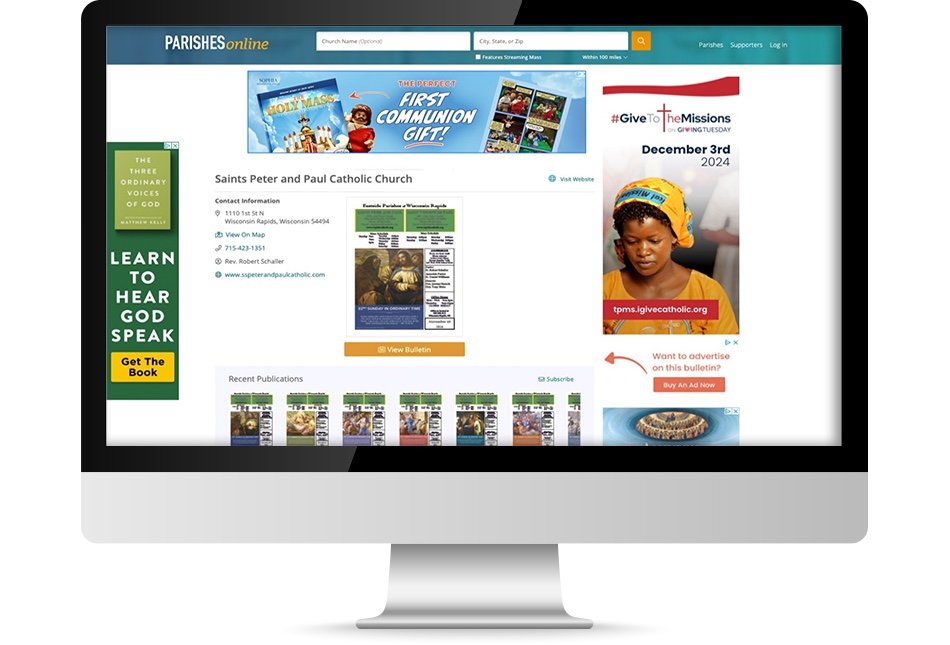
ISSUES FOUND
NEEDS INPUT What was wrong with the old church listing page?
AFTER
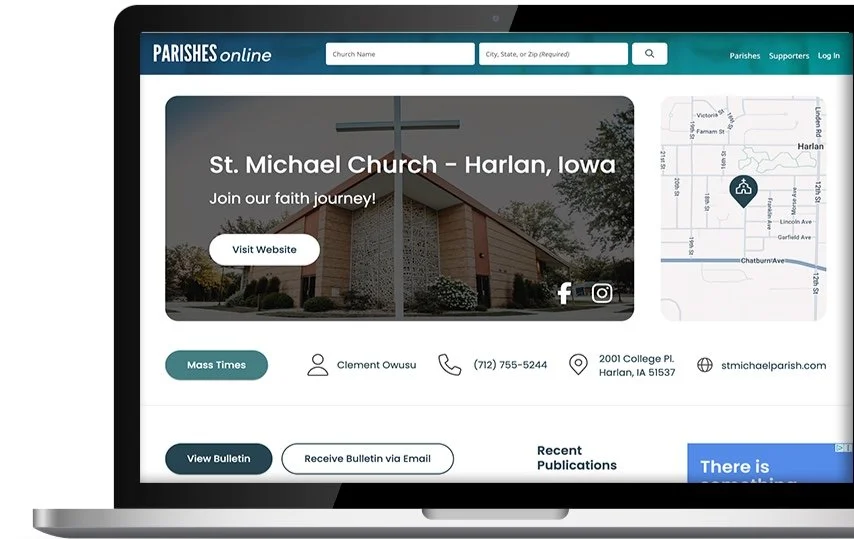
WHAT CHANGED
To confirm: written from the screenshots
A header with the church’s own photo, its name and a Visit Website button.
A map beside the header.
Mass times as a main action.
Contact details in a single row.
Bulletin actions up front: view it, or get it by email.
Ads moved out of the reading path, from three large units around the content to one placement at the side.
Advertiser listings
BEFORE
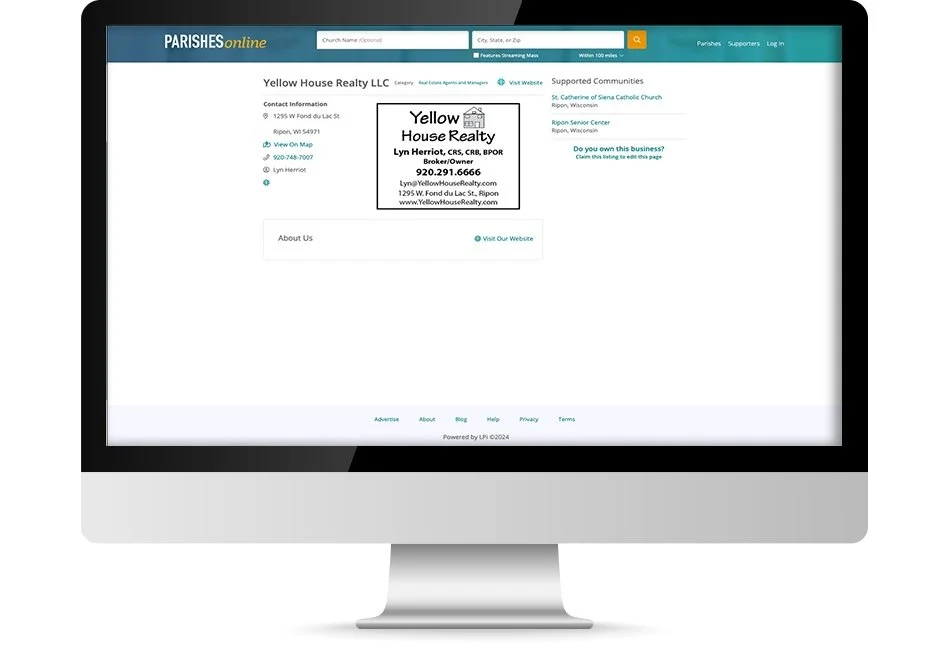
ISSUES FOUND
NEEDS INPUT What was wrong with the old advertiser listing page?
AFTER
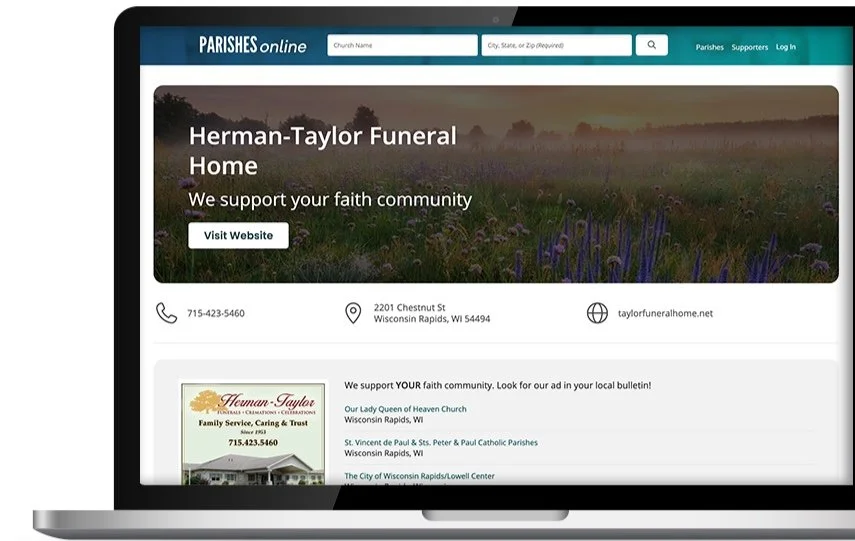
WHAT CHANGED
To confirm: written from the screenshots
A photo header that says “We support your faith community,” with a Visit Website button.
Contact details in a single row.
The business’s print ad shown beside the churches it supports, each linked to its listing.
Rolling it out
With so many existing customers, every change came with its own communication plan. The home page was one of the last large redesigns, so it marked the new vision as fully launched. We told church customers which new features to look for and how to get the most out of their listings.
BUMPS ALONG THE WAY
What made it hard, and what we did
No one owned it
For over a decade, the platform had no product owner, and changes were made one request at a time.
CHANGE I pitched a vision to the CEO and was given full ownership in late 2024, with a roadmap to work from.
Data people couldn’t trust
Mass times were often out of date, and research showed visitors noticed.
CHANGE A partnership with MassTimes.org, and unreliable data points removed. Mass times now stay current through the integration.
Ads that felt like spam
Visitors found the site spammy, and many didn’t connect the ads to the churches they support.
CHANGE Fewer, clearer ad units, and sponsors introduced openly on the home page and in search.
A large base of customers to bring along
Every change touched thousands of churches and advertisers who depend on the platform.
CHANGE A communication plan for every change, telling customers what to look for.
Accessibility failures
Both the home page and search results failed an accessibility audit.
CHANGE Accessibility became a requirement from the start, and ADA cleanup went on the roadmap.
Shallow knowledge of the ad system
Search ads had delivery bugs and inconsistent placements, partly because few people understood how the ad system worked.
CHANGE A rebuilt, simpler ad hierarchy, and a deeper restructure covered in the Ad System Re-Architecture case study.

IMPACT
A more engaged audience, and a business that grew around it
Google Analytics, January 1 to October 19, 2024 compared with the same period in 2026.
Parishes Online
+70%
events, 78.6M to 133.8M
+30%
sessions, 14.5M to 18.9M
+14%
page views, 29.0M to 33.0M
7.5M
active users, steady (7.48M to 7.53M)
Reach held steady while the existing audience became much more active: visitors come back more often and do far more on each visit.
My Community Online, the community version
+98%
active users, 420K to 829K
+89%
sessions, 731K to 1.38M
+95%
events, 4.1M to 8.1M
+62%
page views, 1.46M to 2.37M
The community audience nearly doubled in two years, and it keeps coming back.
The business
$9M+
digital ad revenue projected for 2026, up from a $3.43M goal for 2024
1.1M
active email subscribers, up from about 500K (889,804 church, 225,323 community)
$649K+
in Pub XL ads sold since the format launched in October 2024
To confirm
Customers taking ownership of their listings
Every listing is now claimed. We removed that step: listings are claimed automatically and managed from each customer’s LPi Dashboard. The better sign of adoption is profile photos, which customers add themselves.
1,280
of about 5,200 parishes have added a profile photo
167
of about 1,100 community centers have done the same
Organizations with Mass times

The MassTimes.org partnership brings richer, current data to listings, and better listing pages drive adoption.
New premium inventory. The Pub XL ad format adds higher-value placements across directory listings.
Revenue protected. The related Google Ad Manager retrafficking protected $7.5M on the path from $6.5M in 2025 to a projected $14M in 2028.
WHAT’S NEXT
The LPi Dashboard
The next phase moves advertisers and church staff into a shared, self-serve LPi Dashboard, building on the redesigned directory.
Stickiness
Higher renewal rates, self-serve Dashboard tools and recurring ACH payments to reduce churn.
Efficiency
Email invoicing and a staff Dashboard mean lower costs, less manual work and fewer collections calls.
Data growth
Logged-in visitors create richer data, which makes ad inventory more valuable to advertisers.
Direct revenue
In-context upsells show ad upgrades and open inventory when interest is highest.
CONCLUSION
A neglected directory became a product with an owner
Parishes Online went from a platform nobody owned to one shaped by research with the people who use it. Visitors find churches and Mass times they can trust, church staff can manage their own listings, and advertisers appear as supporters of the community rather than clutter around it.
Ownership started with a vision the CEO could say yes to.
Earn the mandate. A clear, shared vision turned a side project into formal product ownership.
Research every audience. Visitors, church staff and advertisers each needed different things from the same page.
Make ads part of the mission. Being open about sponsors built trust and gave advertisers more value.
Bring customers along. A communication plan for every change kept a large customer base with us.
Parishes Online · Megan Russell · Product Design Manager